Academic project · 2025–2026
Antimicrobial-resistance prediction in Neisseria gonorrhoeae
Evaluating genomic predictors of resistance, with grouped validation and an explicit account of what internal results can establish.
Python / Pandas / scikit-learn
The question
Can genomic unitig features distinguish resistant from susceptible Neisseria gonorrhoeae isolates, and how sensitive are the results to evaluation choices?
This Bioinformatics Computing II course project examined azithromycin and ciprofloxacin resistance. The repository preserves the original submission alongside a reproducibility-focused revision.
Data and approach
I reviewed 3,786 metadata records and matched labelled isolates to antibiotic-specific genomic matrices. Identical complete unitig profiles stay together in five-fold cross-validation. Variance filtering and chi-square feature selection are fitted inside each training fold.
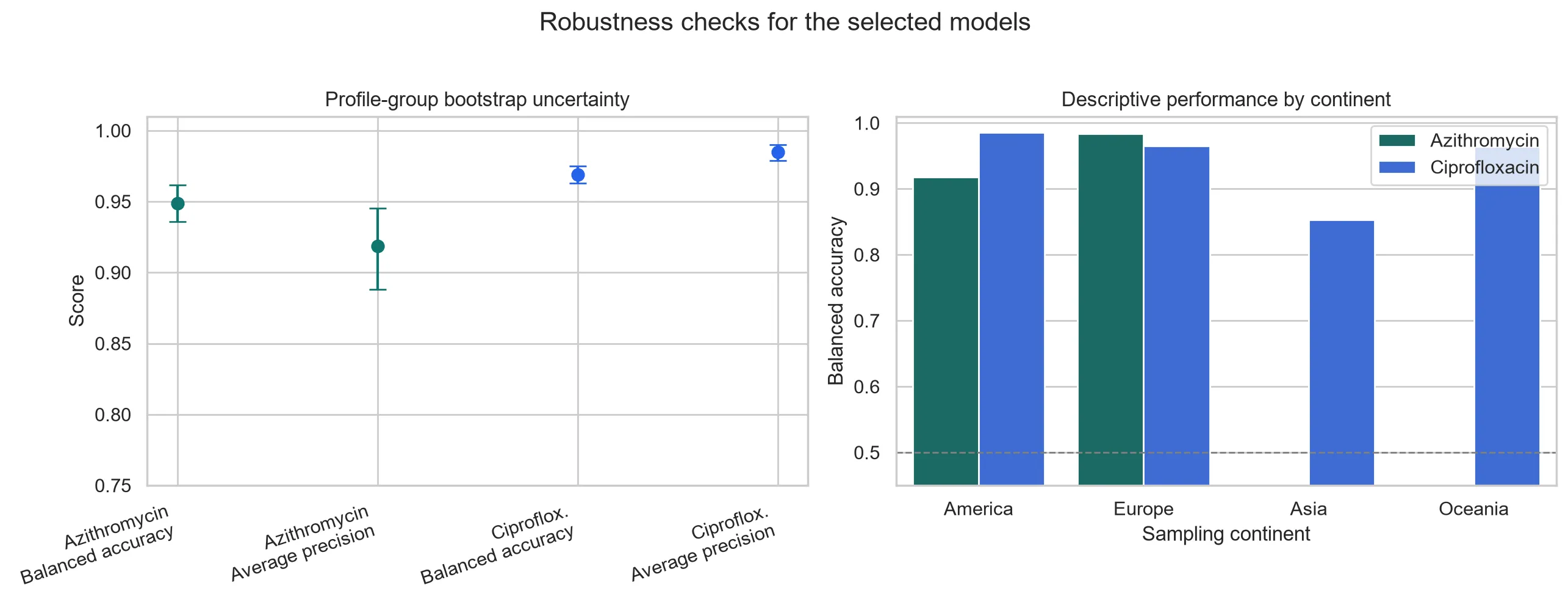
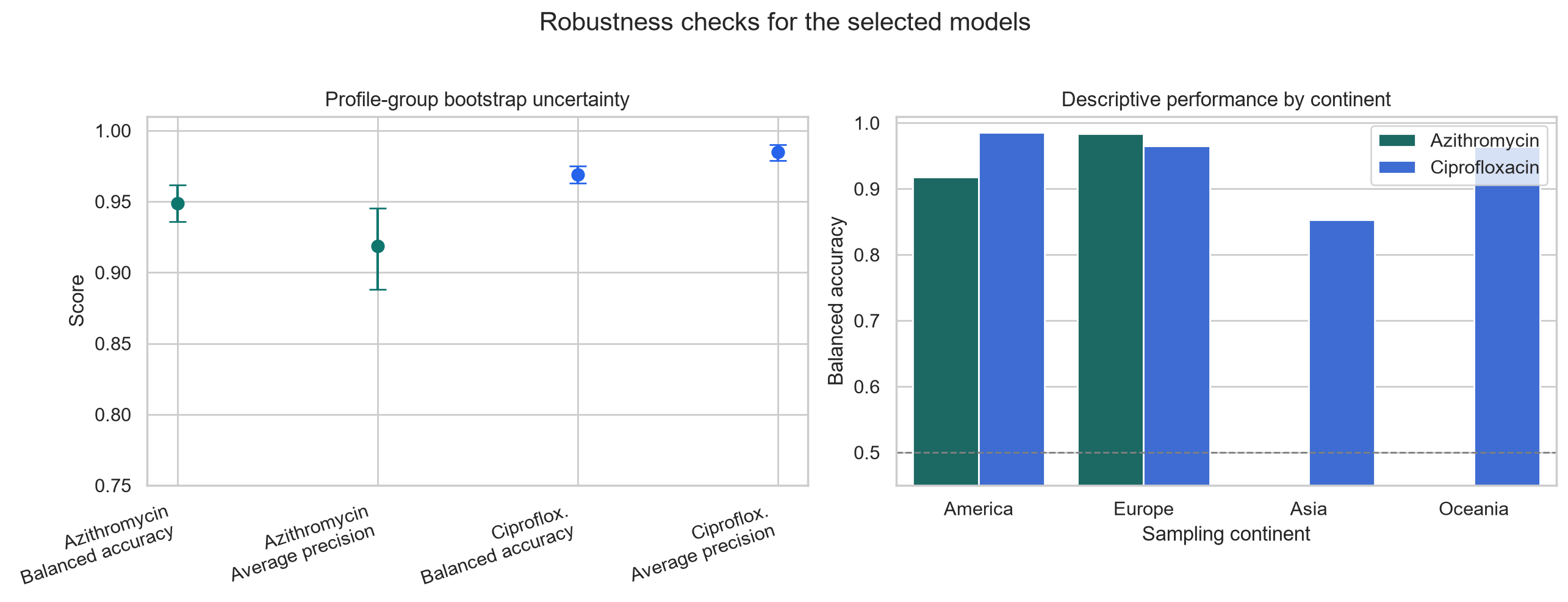
I compared logistic regression and random forest models with a prevalence baseline, then examined sampling variability with profile-group bootstrap intervals and descriptive geographic subgroups.
Results in context
The repository reports the following internal out-of-fold estimates for class-weighted logistic regression:
| Antibiotic | Labelled isolates | Balanced accuracy |
|---|---|---|
| Azithromycin | 3,478 | 0.949 |
| Ciprofloxacin | 3,088 | 0.969 |
These figures describe this internal evaluation. They are not independent validation results. I did not train a cefixime classifier because only five isolates were labelled resistant.
Biological interpretation
BLAST matches for selected unitigs included regions associated with penA and gyrA. These alignments add biological context; they do not establish that a sequence causes resistance.
What I would test next
Independent data and validation that includes upstream feature discovery would provide a stronger test of generalisation. Geographic subgroup differences also warrant evaluation on held-out populations rather than treating descriptive subgroups as external validation.