Portfolio / Professional background & selected work

Muhammad Ekramah

BS Bioinformatics graduate, Quaid-i-Azam University

I study biological data and develop the software around it. These academic projects and internships trace my work in microbial genomics, transcriptomics and Python development.

Genomic AMR · RNA-seq · PathoScope Methods, results and my contribution ↓

Inside the AMR project Academic research

Genomic AMR prediction.

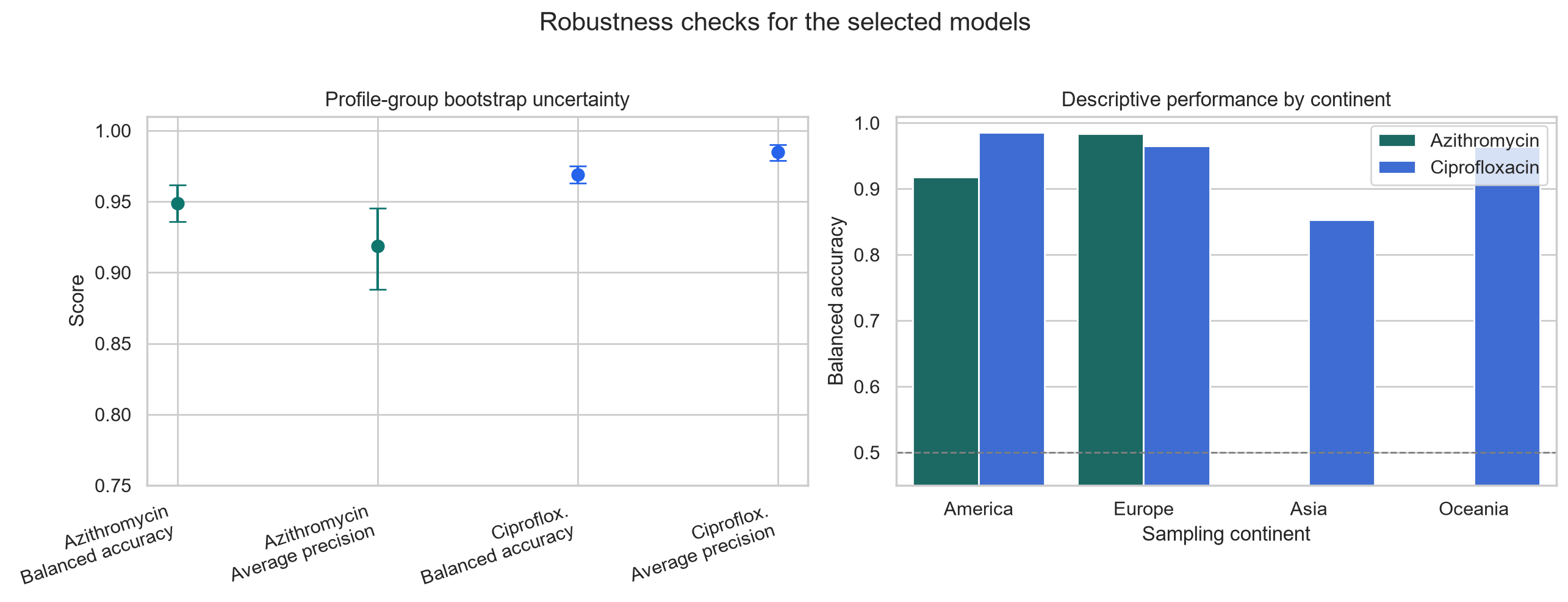
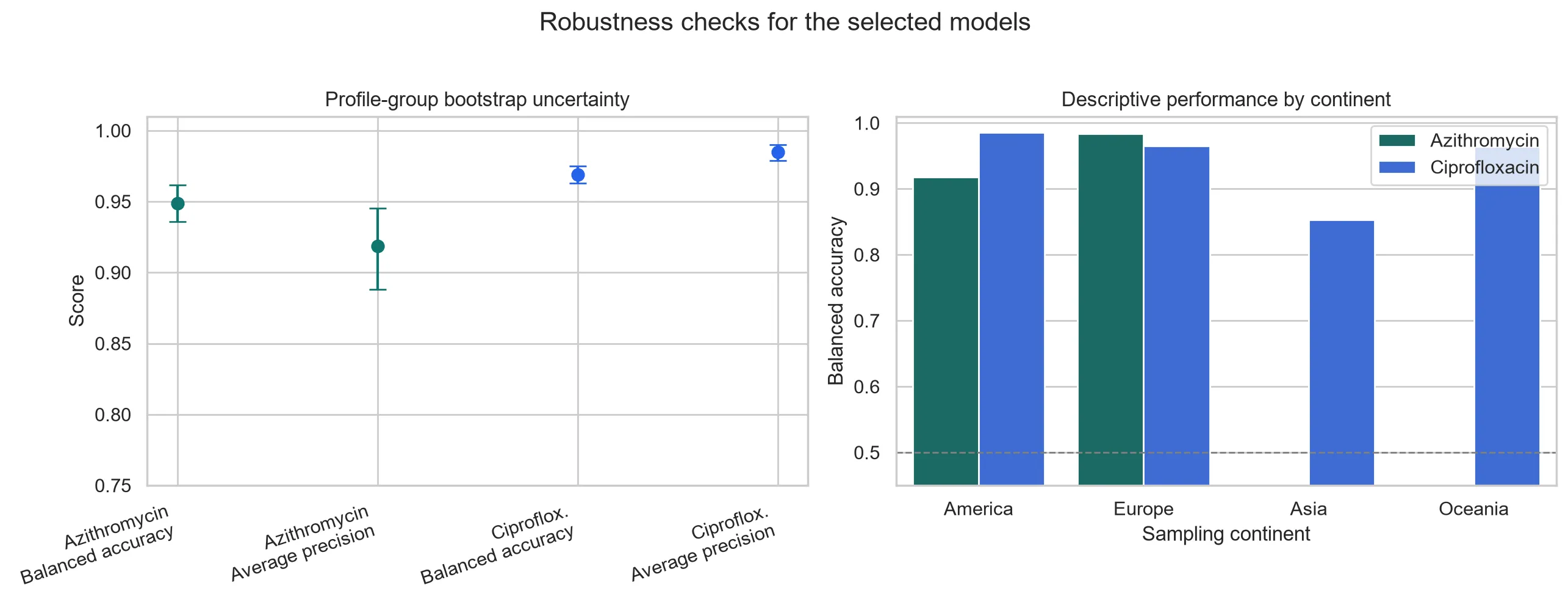
Internal balanced accuracy for two antibiotics Logistic regression: azithromycin 0.949, bootstrap interval 0.936 to 0.962; ciprofloxacin 0.969, interval 0.963 to 0.975. These internal estimates require independent validation. Azithromycin 0.949 Ciprofloxacin 0.969 90% 95% 100%
Balanced accuracy · 95% profile-group bootstrap intervals. Internal evaluation, not clinical validation.

Education

BS in Bioinformatics

Quaid-i-Azam University, Islamabad
National Centre for Bioinformatics

2022–2026

CGPA: 3.40 / 4.00

Relevant coursework

Relevant coursework: Probability and Biostatistics; Bioinformatics Computing; Genomics; Functional Genomics; Systems Biology; Artificial Intelligence; Data Structures and Algorithms; Modelling and Simulation; Database Management Systems.

Professional Experience

  1. Jul–Aug 2025

    Research Intern

    National Institutes of Health (NIH) · Islamabad, Pakistan

    • Used R and the AMR package to analyse antimicrobial-resistance surveillance data, including wastewater data, and summarise susceptibility patterns.
    • Gained exposure to PCR-based diagnostics, Oxford Nanopore MinION sequencing and bulk RNA-seq workflows.

    Tools: R, AMR package

  2. Jul–Sep 2024

    Python Developer Intern

    Digital Empowerment Network · Remote

    • Worked on Python backend services and REST APIs using FastAPI and PostgreSQL.
    • Automated data cleaning and processing with Pandas and NumPy, and developed visualisation utilities for GitHub Classroom analytics as part of a team.

    Tools: Python, FastAPI, PostgreSQL, Pandas, NumPy

Technical Skills

Programming & Backend
Python, R, Bash, FastAPI and REST APIs
Bioinformatics & Genomics
Genomic unitigs, bulk RNA-seq, BLAST, PyDESeq2, DESeq2, FastQC, fastp, HISAT2 and featureCounts
Data Science & Statistics
Pandas, NumPy, PCA, bootstrap intervals and multiple-testing correction
Machine Learning
scikit-learn, logistic regression, random forests, feature selection and grouped cross-validation
Databases & Development Tools
PostgreSQL, SQL, SQLite, Git/GitHub, Linux and Jupyter
Scientific Analysis & Visualization
Differential-expression analysis, negative-binomial modelling, PCA plots, sample-distance heatmaps and gene-expression plots

Selected Projects

Academic research and team development, with methods, results and source code.

Profile-group bootstrap intervals and descriptive continent-level balanced accuracy for the AMR models.
Original project figure. Five hundred profile-group bootstrap resamples and descriptive geographic subgroups from the same out-of-fold predictions; not leave-one-continent-out validation.
Open full-size figure ↗

Academic project · 2025–2026

Genomic AMR prediction

Evaluating genomic predictors of resistance, with grouped validation and an explicit account of what internal results can establish.

Python / Pandas / scikit-learn

Methods
Metadata matching; Profile-grouped cross-validation; Fold-specific feature selection and bootstrap intervals.
Results
Internal balanced accuracy of 0.949 for azithromycin and 0.969 for ciprofloxacin; independent validation is still needed.
Limitations
Internal cross-validation only. Supplied features were already GWAS-filtered, so upstream selection leakage cannot be excluded. These results do not establish clinical utility.
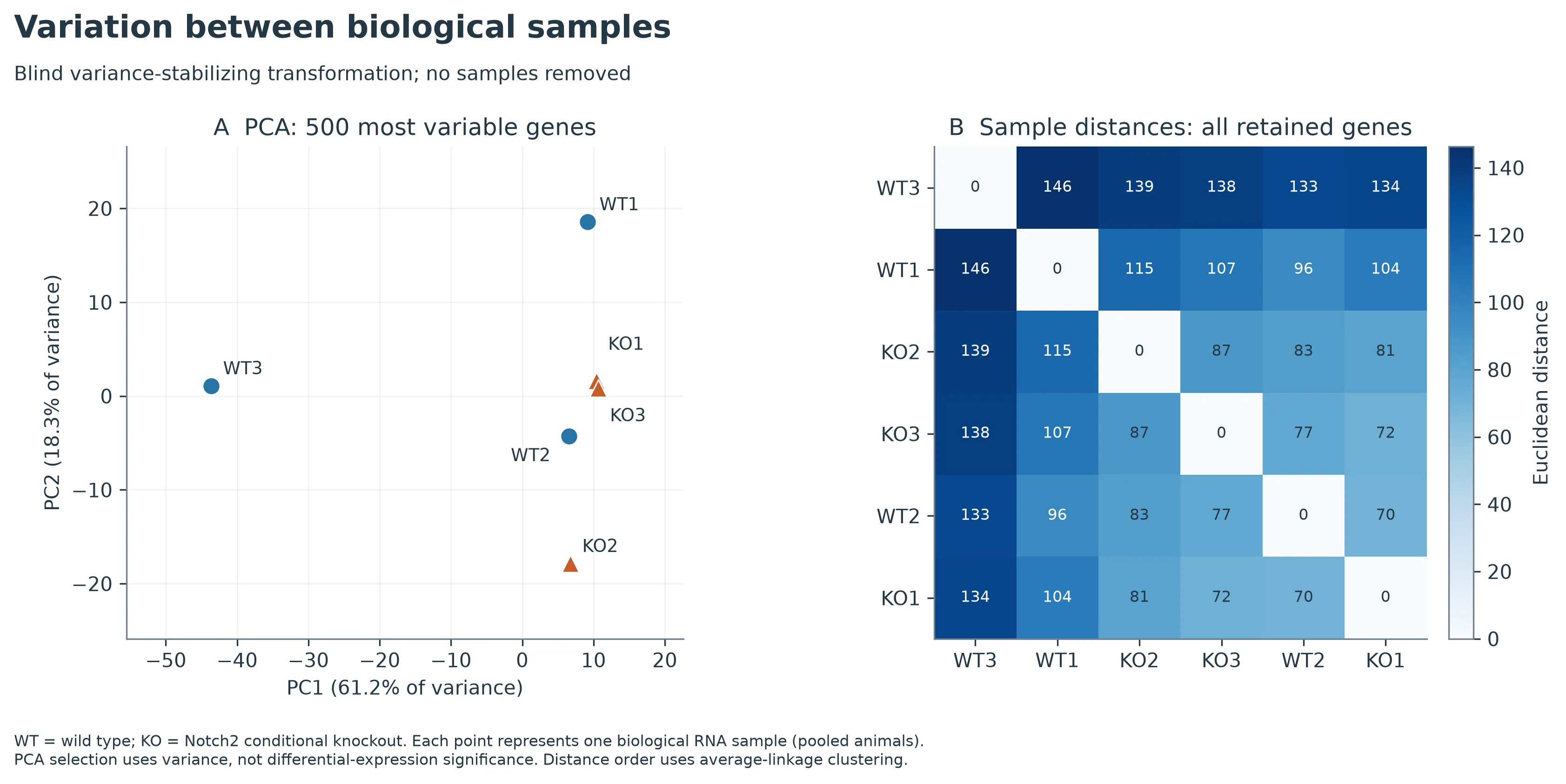
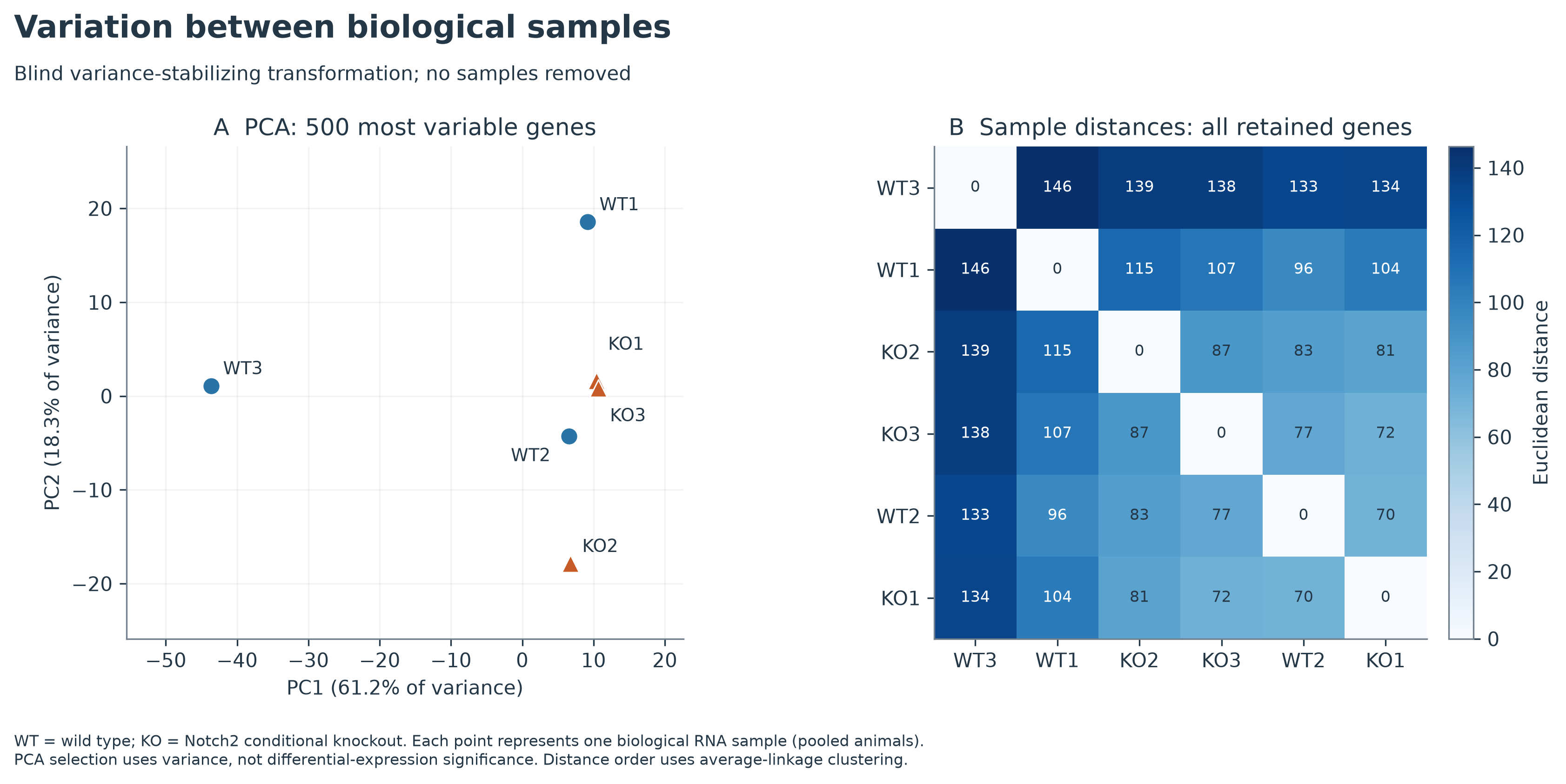
PCA and sample-distance heatmap for six biological samples, showing separation of WT3.
Original project figure, reproduced under the repository MIT licence. PCA of the 500 most variable genes after blind variance stabilisation; sample distances use retained VST genes. PC1 explains 61.2% and PC2 18.3% of variance.
Open full-size figure ↗

Academic project · 2025–2026

Reading an RNA-seq experiment

A public-data reanalysis that keeps biological replication, sample structure and the limits of differential expression in view.

Python / PyDESeq2 / R / Bash

Methods
Combine technical files into biological samples; PyDESeq2 differential-expression analysis; PCA and sample-distance review.
Results
121 genes met FDR < 0.05 among 21,531 retained genes. Three samples per condition and the distinct WT3 sample limit interpretation.
Limitations
Three biological samples per condition, with WT3 differing from the other samples. Differential expression alone does not establish direct regulation by Notch2.

Team prototype · Mar–Aug 2026

PathoScope AI

A team-built research software prototype connecting viral sequence workflows, expression exploration and literature retrieval.

Python / FastAPI / PostgreSQL / NCBI E-Utilities

Methods
Backend workflow execution and job tracking; FASTQ integration and database connectivity; PubMed retrieval and report generation.
Results
A working course prototype connects research workflows and literature retrieval. Some fallbacks use simulated outputs; it is not a validated diagnostic pipeline.
Limitations
A course prototype, not a validated diagnostic pipeline. Some fallbacks use simulated annotations or a substitute reference sequence. AI literature summaries need human review.

Additional Work

Additional Projects & Prototypes

Independent, AI-assisted software demonstrations with public setup and validation records. These are separate from the internships and academic projects above.

Contact & Professional Links

For research opportunities or a defined development project, get in touch with the question and the output you need.

Email